Success often looks effortless when people see it from the outside. They see the successful company, the impressive career, the growing audience, the financial achievements, the awards, or the recognition, but they rarely see the years of preparation that came before those visible results. They see the celebration, but they do not see the countless ordinary days when nobody was watching.
The most important work often happens when there is no applause, no audience, no recognition, and no immediate reward. It happens when you continue learning, practicing, building, improving, and solving problems even though nobody is paying attention yet.
Before people recognize the result, you have to become capable of producing it. Before the world sees the achievement, you have to spend time developing the discipline, knowledge, skills, patience, and resilience required to create that achievement.
The quiet stage is not a meaningless part of success. It is where success is constructed.
The World Usually Sees the Result, Not the Process
People naturally notice visible outcomes. They notice when a business becomes successful, when an entrepreneur launches an impressive product, when an athlete wins, or when a professional reaches an important position.
What they often do not see are the thousands of decisions that made that moment possible.
They do not see the early mornings, the late nights, the failed experiments, the rejected ideas, the difficult conversations, the countless hours of learning, or the moments when quitting seemed easier than continuing.
Success can look sudden from the outside because people are seeing the final result rather than the process that produced it.
The process may have taken years.
The Silent Stage Is Where You Build Yourself
Before you can build something extraordinary, you often have to build yourself into someone capable of creating it.
You need to develop knowledge, discipline, patience, confidence, communication skills, decision-making ability, and the ability to remain focused when results are slow.
These qualities are rarely developed in public moments.
They are developed through repetition.
You become disciplined by keeping commitments when nobody is checking. You become knowledgeable by studying when there is no exam forcing you to learn. You become resilient by continuing after setbacks. You become skilled by practicing when nobody is impressed by your early attempts.
The quiet work changes you before it changes your circumstances.
Nobody May Notice Your First Efforts
When you begin something new, there may be very little external validation.
Your first business may have few customers. Your first videos may receive very little attention. Your first product may not generate significant sales. Your first attempts at developing a skill may look unimpressive.
That is normal.
Every successful journey has an early stage where the results are small compared with the vision.
The mistake is assuming that small beginnings mean the effort is worthless.
Early work is often preparation for later results.
Do the Work Before Seeking Recognition
It is tempting to seek recognition too early.
You may want people to know what you are building before you have built it. You may want praise for your plans before you have produced results. You may want others to believe in you before you have evidence that your idea works.
But attention is not the same as achievement.
Instead of focusing on convincing everyone that you will succeed, focus on becoming capable of succeeding.
- Build the product.
- Improve the skill.
- Study the market.
- Serve the customer.
- Develop the system.
- Create the results.
- Recognition can come later.
Quiet Progress Is Still Progress
Not all progress is visible.
You may spend weeks learning something without seeing an immediate financial reward. You may improve your business systems without receiving public recognition. You may develop better habits without anyone noticing.
That does not mean nothing is happening.
Your knowledge is increasing. Your judgment is improving. Your confidence is becoming stronger because it is based on experience. Your ability to handle difficult situations is developing.
These improvements may not be visible today, but they can become the foundation for tomorrow’s results.
Success Requires Patience
One of the biggest differences between people who continue building and people who quit is their relationship with time.
Some people expect immediate results. If success does not appear quickly, they assume the strategy is not working.
Others understand that meaningful results can take time.
A business may need years to develop. A valuable skill may require thousands of hours of practice. A strong reputation may require countless positive interactions. A major project may require repeated failures and improvements.
Patience does not mean waiting passively.
It means continuing to work while allowing time for your efforts to compound.
The Quiet Period Tests Your Commitment
When nobody is watching, it becomes easier to stop.
There is no audience demanding that you continue. There may be no applause when you finish the day’s work. There may be no immediate reward for learning another skill or solving another problem.
This is where commitment becomes important.
If you continue even when external motivation is low, you prove to yourself that your goal matters.
The quiet period reveals whether you are working only for recognition or whether you genuinely believe in what you are building.
Discipline Works Behind the Scenes
Motivation may inspire you to begin, but discipline helps you continue.
There will be days when you do not feel excited about the work. There will be days when progress seems slow. There will be days when distractions are more attractive than your responsibilities.
Discipline means continuing to do what matters despite temporary feelings.
A successful business is not built only on days when the founder feels inspired. A successful career is not built only when motivation is high.
Progress comes from repeatedly completing important work.
That repetition often happens quietly.
Learn While Nobody Is Watching
One of the greatest advantages you can create during the silent stage is knowledge.
Study your industry. Understand your customers. Learn new technologies. Improve your communication. Analyze successful businesses. Read about failures. Practice your craft.
You do not need an audience for learning to be valuable.
Every new skill increases your capabilities.
When the right opportunity eventually appears, the preparation you completed privately can determine whether you are ready to take advantage of it.
Preparation creates options.
Failure Often Happens Before Recognition
People sometimes imagine successful people as individuals who always knew what they were doing.
The reality is usually different.
Many successful people experience failed ideas, unsuccessful products, wrong decisions, rejected proposals, financial difficulties, and disappointing results before reaching a higher level.
- Failure is often part of the construction process.
- The important question is not whether you fail.
- The important question is whether you learn.
If every failed attempt provides information that improves the next attempt, failure becomes part of your education.
Do Not Compare Your Behind-the-Scenes With Someone Else’s Highlight Reel
Social media makes comparison especially difficult because people usually display their best moments.
- You see someone’s success, but you may not see the years that preceded it.
- You see the new business, but not the failed businesses that came before it.
- You see the achievement, but not the preparation.
- You see the celebration, but not the uncertainty.
Comparing your current stage with someone else’s most visible result can make your own progress appear smaller than it really is.
Remember that every journey has a hidden chapter.
Protect Your Focus
Not every goal needs to be announced publicly.
Sometimes sharing your plans can create unnecessary pressure or distraction. You may spend more energy explaining what you intend to do than actually doing it.
Protecting your focus allows you to spend more time building.
This does not mean you should hide everything or avoid networking. Communication and collaboration are important.
It means you should understand the difference between useful visibility and unnecessary attention.
Let your work receive the energy that would otherwise be spent trying to impress people.
Results Speak More Clearly Than Promises
It is easy to tell people what you plan to accomplish. It is much harder to actually accomplish it.
Promises can create temporary excitement, but results create lasting credibility.
- Instead of constantly explaining what you are going to build, spend more time building it.
- Instead of repeatedly telling people you are becoming better, develop the skills that demonstrate improvement.
- Instead of announcing every step, allow your progress to accumulate. Eventually, results can communicate what words cannot.
Build When Nobody Believes Yet
Some ideas appear unrealistic at the beginning.
People may question whether you can succeed. They may not understand your strategy. They may not see the opportunity you see.
You do not need universal approval to begin.
Listen to useful criticism, but do not allow every opinion to determine your direction.
If you believe there is genuine value in what you are building, investigate the idea, test it, improve it, and let evidence guide you.
You do not have to prove everything immediately.
You have to keep learning.
The Early Stage Is Supposed to Feel Difficult
When you are building something from the ground up, there is often a large gap between your vision and your current reality.
That gap can be frustrating.
You may know what you want but not yet know how to achieve it. You may have ambition without resources. You may have an idea without a team. You may have skills but not enough experience.
- This is not necessarily a sign that you should quit.
- It can simply mean that you are at the beginning.
- Use the gap as a roadmap.
- Identify what you need to learn, build, acquire, or improve.
Small Wins Build Momentum
Not every achievement needs to be enormous. Getting your first customer matters.
Completing your first project matters. Learning your first advanced skill matters.
Improving your process matters. Solving a problem that previously stopped you matters.
These small victories create evidence that progress is possible. Over time, small wins can build momentum.
The public may not notice each one, but you know how much work went into creating them.
Build Systems, Not Just Motivation
If you want long-term success, do not rely entirely on motivation.
Create systems that support your goals.
Schedule important work. Track progress. Create routines. Organize your priorities. Reduce distractions. Review your results. Identify what is working and what is not.
Systems allow you to continue making progress even when motivation changes.
The strongest businesses and careers are not built through occasional bursts of enthusiasm.
They are built through repeatable processes.
Your Standards Matter in Private
The standard you maintain when nobody is watching often reveals the level you are preparing yourself to operate at.
If you accept careless work in private, that behavior can eventually appear in public.
If you consistently demand quality from yourself, that quality can become part of your reputation.
You do not need someone standing over you to take your work seriously.
Developing strong personal standards is one of the most valuable things you can do during the quiet stage.
Use Silence to Develop Confidence
Real confidence is not always loud.
Sometimes confidence comes from knowing that you have prepared.
You have studied the subject. You have practiced the skill. You have tested the idea. You have experienced setbacks and learned how to respond.
This kind of confidence does not require constant validation.
It comes from evidence.
Every time you keep a commitment to yourself, you build a little more trust in your own ability.
Over time, that self-trust can become powerful.
Keep Working Through Uncertainty
You will not always know whether your effort will produce the desired outcome. That uncertainty is part of building something meaningful.
If you wait until you have complete certainty, you may never begin. Instead, gather information, make the best decision you can, take action, measure the result, and adjust.
Progress often comes through experimentation rather than perfect prediction.
The silent stage is where much of this experimentation happens.
Your Future Reputation Is Being Built Today
Every action contributes to the reputation you will eventually have.
- How you handle small responsibilities can influence how people trust you with larger ones.
- How you treat customers can influence whether they recommend you.
- How you work with teammates can influence whether people want to collaborate with you again.
- How you respond to failure can influence how others perceive your leadership.
Your future reputation is being built through today’s behavior.
Even when nobody is celebrating it yet.
Success Requires Becoming Before Having
Many people focus heavily on what they want to have.
They want the successful company, the financial freedom, the leadership position, the recognition, or the influence.
But achievement often requires becoming a different kind of person first.
You may need to become more disciplined.
- More patient.
- More knowledgeable.
- More resilient.
- More organized.
- More adaptable.
- More comfortable with responsibility.
The silent stage gives you the time to develop these qualities.
The external result often arrives after the internal transformation has already begun.
Do Not Quit Because Nobody Notices
Lack of recognition can be discouraging.
You may work hard and receive little feedback. You may improve your business while competitors receive more attention. You may develop skills while others appear to progress faster.
- Remember why you started.
- If your entire motivation depends on other people’s recognition, your commitment will always be vulnerable.
- Build because the work matters.
- Learn because you want to become capable.
- Improve because you want better results.
- Create because you believe the solution should exist.
- Recognition can be rewarding, but it should not be the only reason you continue.
The Quiet Years Can Become Your Strongest Years
The years when nobody knows your name can be some of the most valuable years of your development.
- You have room to experiment.
- You can make mistakes without enormous public pressure.
- You can learn.
- You can change direction.
- You can build skills.
- You can discover what works.
- You can create a foundation.
- Do not underestimate these years.
The person you become during this period can determine what you are capable of doing later.
Let Your Work Become Your Introduction
Instead of constantly trying to convince people of your potential, develop work that demonstrates it.
- A strong portfolio can demonstrate ability.
- A successful product can demonstrate execution.
- Satisfied customers can demonstrate value.
- Consistent results can demonstrate reliability.
- A growing business can demonstrate leadership.
- Your work becomes evidence.
You no longer have to spend as much time explaining what you can do because the results begin speaking for you.
Public Success Is Often Private Discipline Made Visible
When people celebrate a major achievement, they are often celebrating the visible outcome of countless invisible decisions.
- The discipline was private.
- The learning was private.
- The mistakes were private.
- The preparation was private.
- The persistence was private.
The breakthrough becomes public only after enough invisible work has accumulated.
This is why you should never underestimate the power of an ordinary day.
One day of work may not create success.
But thousands of ordinary days can create extraordinary results.
Keep Building Even When Progress Feels Invisible
There will be periods when you feel like your efforts are producing nothing.
This is one of the hardest parts of long-term growth.
You may not see immediate evidence that your learning is working. You may not see immediate financial results. You may not receive recognition.
Continue evaluating your process, but do not confuse a lack of immediate visibility with a lack of progress.
Some results are delayed.
Keep improving the inputs while monitoring the outputs.
If the strategy needs to change, change it.
If the goal still matters, keep building toward it.
Your Quiet Work Is Creating Your Future
Every hour you spend learning, every problem you solve, every mistake you analyze, and every commitment you keep is shaping the person you are becoming.
Your future does not suddenly appear on the day you achieve success.
It is constructed gradually through the choices you make beforehand.
The public moment is simply when other people finally see what you have been building privately.
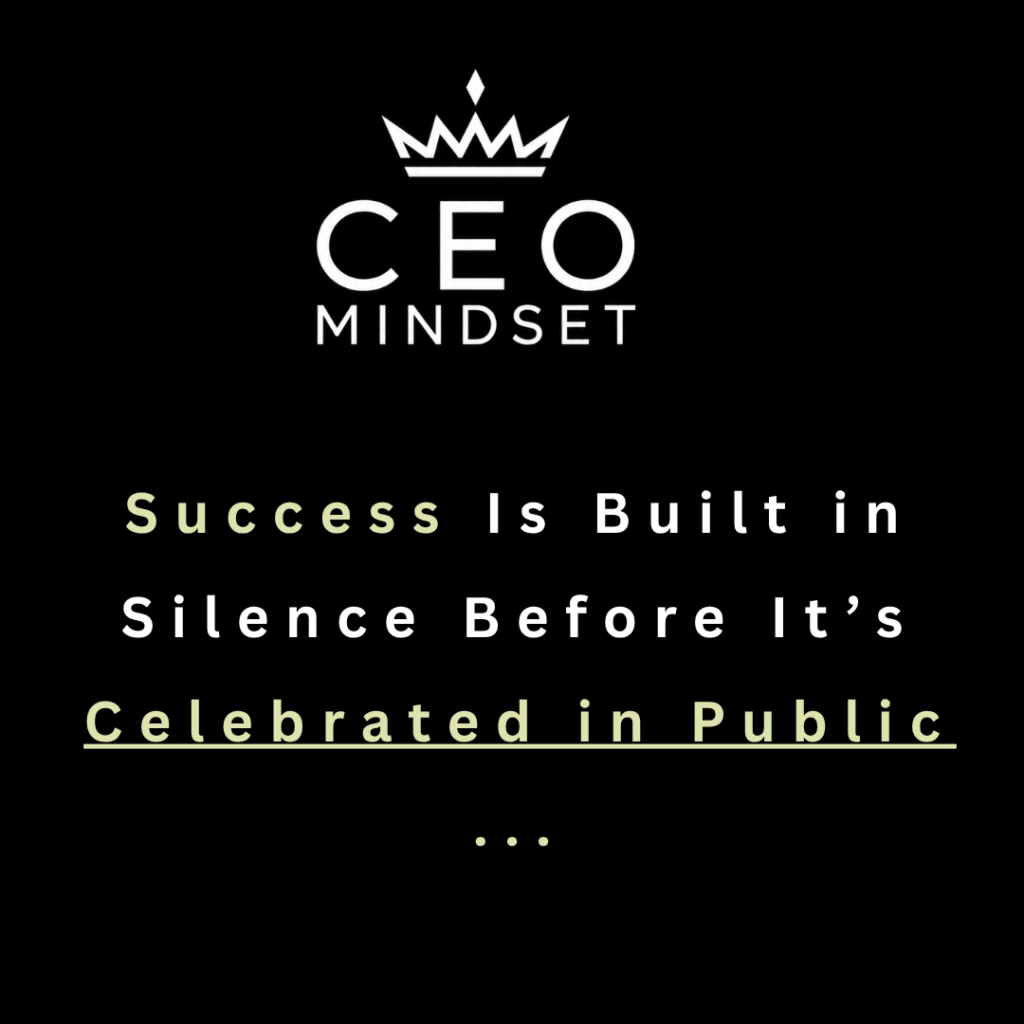
Success Is Built in Silence Before It’s Celebrated in Public
Success often has two different stages: the stage where you build and the stage where people notice what you built.
The first stage is usually much longer.
It requires patience when there is little recognition, discipline when motivation disappears, courage when others doubt you, and consistency when results are still small.
This is where your foundation is created.
Before a successful company becomes visible, someone spends countless hours solving problems that customers may never know existed. Before a skilled professional receives recognition, they spend years learning and practicing. Before a creator develops a large audience, they often produce countless pieces of work that receive very little attention.
The public sees the achievement.
The builder remembers the process.
That process matters.
Do not become discouraged because your current efforts are not receiving applause. Applause is not proof of progress, and silence is not proof of failure.
There are seasons when your job is simply to build.
- Build your knowledge.
- Build your skills.
- Build your discipline.
- Build your systems.
- Build your relationships.
- Build your reputation.
- Build your product.
- Build your confidence through experience.
- Build yourself into the person capable of handling the success you want.
When you focus on these things, you stop depending on immediate recognition. You begin understanding that the quiet period is not time wasted. It is preparation.
The world may not see the hours you spend improving yourself, but those hours are changing what you are capable of doing. The world may not see the failures you experience, but those failures can improve your judgment. The world may not see the small improvements you make each day, but those improvements can compound into something significant.
Do not rush the foundation.
A strong building requires strong foundations, and meaningful success works the same way.
When the time comes for your results to become visible, people may call it luck, timing, talent, or sudden success. They may see the final achievement and assume it happened quickly.
- You will know better.
- You will remember the quiet mornings.
- You will remember the difficult decisions.
- You will remember the failed attempts.
- You will remember the days when nobody believed.
- You will remember continuing when there was no applause.
That is the hidden side of success.
The celebration is public, but the construction is often private.
So keep working when nobody is watching. Keep learning when nobody is asking. Keep improving when nobody is complimenting you. Keep building when the results are still small.
Because the work you do in silence today can become the achievement people celebrate tomorrow.
Success is built in silence before it is celebrated in public, and the person willing to master the quiet work is often the person prepared to handle the loud success when it finally arrives.