
Failure is one of the most misunderstood parts of success. Many people see failure as a final judgment—a sign that they were not talented enough, smart enough, prepared enough, or capable enough. But successful people often see failure differently. They understand that failure can provide information that success sometimes cannot.
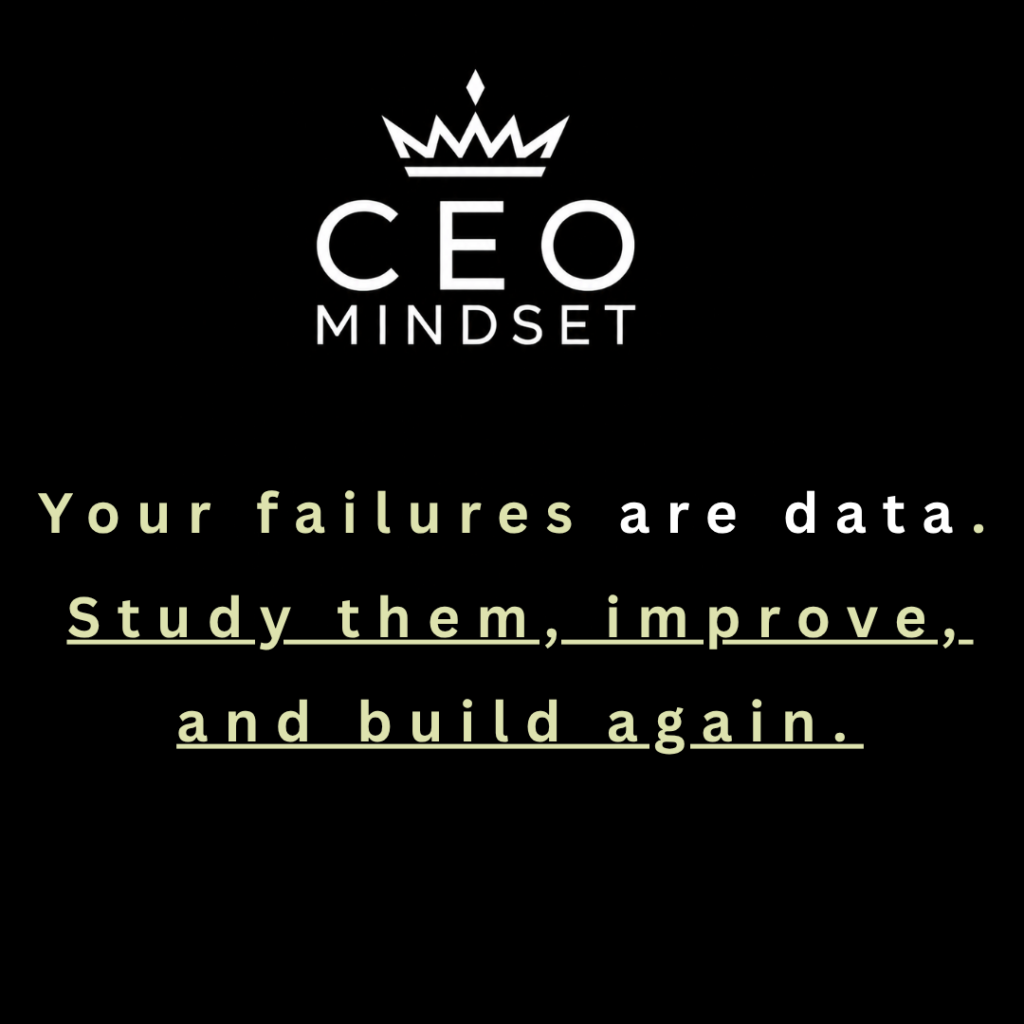
Your failures are data. Study them, improve, and build again.
Every failed attempt can reveal something. It can show you what customers do not want, where your strategy was weak, which assumptions were incorrect, what skills you need to develop, or what needs to change before you try again.
Failure does not have to be the opposite of success.
Sometimes, it is part of the process that creates success.
Failure Is Information
When something does not work, you have learned something valuable.
Perhaps the product did not solve the problem you thought it would solve. Perhaps your marketing message failed to connect with the audience. Perhaps your business model was too expensive. Perhaps your timing was wrong. Perhaps the execution was not strong enough.
Whatever the reason, the result contains information.
Instead of simply saying, “It failed,” ask:
What exactly failed?
- That question changes everything.
- The idea may not have failed.
- The timing may have failed.
- The execution may have failed.
- The communication may have failed.
- The pricing may have failed.
- The target audience may have been wrong.
- The strategy may have been incomplete.
When you identify the actual problem, failure becomes more useful.
Separate the Failure From Your Identity
One unsuccessful attempt does not mean you are unsuccessful.
- A failed business does not automatically make you a failed entrepreneur.
- A rejected idea does not mean you are incapable of creating good ideas.
This distinction is extremely important.
When people connect failure to their identity, they become afraid to try again. They think another attempt might prove that their negative beliefs were correct.
A stronger mindset separates the result from the person.
You can say:
“This did not work.”
without saying:
“I cannot succeed.”
The first statement describes an outcome.
The second creates a permanent limitation.
Study What Happened
After a failure, emotion can make it difficult to think clearly.
You may feel disappointed, embarrassed, frustrated, or angry.
Give yourself time to process those emotions, but eventually return to the facts.
- What happened?
- What was the original goal?
- What did you expect?
- What actually happened?
- Where was the difference?
- Which assumptions turned out to be wrong?
- Which decisions contributed to the result?
- What could have been done differently?
These questions turn an emotional experience into a learning opportunity.
Look for the Root Cause
One of the biggest mistakes people make after failure is fixing the wrong problem.
Suppose a product receives very few sales.
The immediate conclusion might be, “Nobody wants this product.”
But that may not be true.
- Maybe the product was poorly marketed.
- Maybe customers did not understand its value.
- Maybe the price was too high.
- Maybe the product was difficult to use.
- Maybe it was promoted to the wrong audience.
- Maybe the sales process was weak.
A strong problem-solving mindset goes deeper. Do not stop at the first explanation.
Find the root cause.
The better you understand why something failed, the better your next version can become.
Turn Mistakes Into Lessons
Every mistake should produce a lesson.
If you make the same mistake repeatedly without learning from it, failure becomes expensive.
But if one mistake teaches you something important, it can become an investment in your future.
- A failed marketing campaign can teach you about your audience.
- A rejected job application can teach you where your skills need improvement.
- A failed product can teach you about customer needs.
- A difficult business decision can teach you about risk.
- A leadership mistake can teach you about communication.
The lesson is often more valuable than the original result.
Don’t Repeat the Same Experiment Blindly
Trying again does not mean doing exactly the same thing and expecting a different result.
If the first approach failed, something needs to change.
- Change the strategy.
- Improve the product.
- Test a different audience.
- Adjust the pricing.
- Strengthen the communication.
- Develop the missing skill.
- Improve the process.
- Find better information.
A second attempt should be smarter than the first.
Your goal is not simply to repeat.
Your goal is to iterate.
Build Again, But Build Better
One of the most powerful responses to failure is rebuilding.
- Take what you learned and apply it.
- The second version should contain lessons from the first.
- The third version should contain lessons from the second.
- Over time, repeated improvement can create something dramatically better than the original.
- This is how many successful products and businesses evolve.
- They are not perfect from the beginning.
- They improve through feedback.
- They become stronger through iteration.
The process looks simple:
Build → Measure → Learn → Improve → Build Again.
That cycle can turn failure into progress.
Small Experiments Reduce Big Losses
You do not always need to risk everything to learn something.
When uncertainty is high, small experiments can be powerful.
- Instead of investing a huge amount of money into an untested idea, test a smaller version.
- Instead of building every feature at once, create a basic version.
- Instead of targeting an enormous audience immediately, test with a smaller group.
- Instead of completely changing your strategy overnight, experiment with one part of it.
Small experiments provide data without creating unnecessary risk.
If the experiment fails, you have learned something without destroying the entire project.
Measure What Matters
Learning from failure requires measurement.
You cannot improve what you do not understand.
Depending on the situation, you may need to examine sales, conversion rates, customer feedback, retention, engagement, costs, productivity, response times, or other meaningful indicators.
Numbers are not the entire story, but they can reveal patterns that emotions hide.
For example, you may believe that customers dislike your product because sales are low. But the data may show that people are interested in the product but abandon the purchasing process because checkout is complicated.
The data changes the problem.
And once the problem is clearer, the solution becomes easier to find.
Listen to Feedback Without Losing Your Vision
- Feedback can be uncomfortable.
- People may criticize your product.
- Customers may point out weaknesses.
- Employees may disagree with your strategy.
- Investors may question your decisions.
- Your first reaction may be to defend yourself.
Instead, listen carefully.
Not every piece of feedback is correct, but every piece of feedback can contain information.
Ask:
Is there a pattern here?
If one person complains, it may be an isolated opinion.
If hundreds of customers report the same issue, it is probably worth investigating.
Strong leaders do not accept every criticism blindly.
They examine it intelligently.
Failure Can Reveal Hidden Opportunities
Sometimes failure reveals an opportunity you could not see before.
- A product may fail with its original audience but succeed with a different audience.
- A feature may not attract customers, but another part of the product may receive strong interest.
- A business model may not work as planned, but the underlying technology may have another valuable application.
- A failed project can expose a completely different opportunity.
This is why you should not immediately throw away everything after failure.
Look closely.
- Ask what worked.
- Ask what people responded to.
- Ask what unexpected information emerged.
Sometimes the next opportunity is hidden inside the failed attempt.
Don’t Let Ego Block Learning
Ego can make failure harder to learn from.
If you become emotionally attached to an idea, you may refuse to accept evidence that contradicts your assumptions.
- You may blame customers.
- You may blame competitors.
- You may blame the market.
- You may blame timing.
Sometimes those factors genuinely matter.
But strong leaders also ask:
“What part of this was my responsibility?”
Taking responsibility does not mean blaming yourself for everything.
It means recognizing where you have influence.
That mindset creates power because what you can take responsibility for, you can often improve.
Learn Faster Than Your Competitors
In competitive markets, mistakes are inevitable.
- The real advantage can come from how quickly you learn from them.
- If your company makes a mistake and learns immediately, it can adapt.
- If a competitor makes a mistake and refuses to acknowledge it, they may repeat it.
- A company that learns quickly can improve faster.
- This creates a powerful competitive advantage.
- You do not need to avoid every mistake.
- You need to become better at learning from mistakes than the people competing with you.
Don’t Romanticize Failure
- Failure can be valuable, but that does not mean every failure is automatically good.
- There is no benefit in repeating avoidable mistakes.
- There is no virtue in ignoring evidence.
- There is no reason to continue with a strategy that clearly does not work simply because you have already invested time or money into it.
- Learning from failure means being willing to change.
- Sometimes the correct response is to rebuild.
- Sometimes it is to change direction.
- Sometimes it is to stop.
- The goal is not to keep going blindly.
The goal is to make a better decision because of what you have learned.
Resilience Is Built Through Recovery
- Resilience does not mean never falling.
- It means learning how to get back up.
- Every time you experience a setback and respond constructively, you develop greater confidence in your ability to handle future challenges.
- You learn that disappointment is survivable.
- You learn that mistakes can be corrected.
- You learn that uncertainty can be managed.
- You learn that setbacks do not have to define your future.
- This creates mental strength.
Your Next Version Can Be Better
You are not required to remain the same person who made the original mistake.
- You can learn.
- You can improve.
- You can develop new skills.
- You can change your strategy.
- You can become more disciplined.
- You can become better prepared.
- Your next attempt can be stronger because you are no longer starting from zero.
- You are starting with experience.
That experience has value.
Use Failure as a Feedback Loop
- The strongest builders create feedback loops.
- They do something.
- They observe the result.
- They identify what happened.
- They learn.
- They make adjustments.
- Then they try again.
This process can happen in business, careers, leadership, fitness, learning, and almost every area of life.
You do not need to get everything right on the first attempt.
You need a system that allows you to improve after every attempt.
Keep Building
There will be moments when failure makes you want to stop.
That feeling is understandable.
But before you quit, ask yourself whether you are truly finished—or whether you simply need a better approach.
- Maybe the goal still matters.
- Maybe the idea still has potential.
- Maybe the strategy needs to change.
- Maybe you need more knowledge.
- Maybe you need more time.
- Maybe you need to rebuild.
Do not confuse a failed attempt with a failed future.
Your story is not determined by the number of times something goes wrong.
It is shaped by what you do afterward.
Turn Setbacks Into Strength
- Every failure contains information.
- Study it.
- Understand it.
- Accept responsibility where necessary.
- Identify the root cause.
- Change what needs to change.
- Test again.
- Improve.
- Build again.
- That is how setbacks become stepping stones.
- Your failures are data. Study them, improve, and build again.
Do not waste a failure by allowing it to become only a painful memory. Extract the lesson. Turn the experience into knowledge. Turn the knowledge into a better strategy. Turn the strategy into action.
- Your first version may fail.
- Your second version may struggle.
- Your third version may finally begin to work.
- Keep learning.
- Keep improving.
- Keep building.
Because success does not always belong to the person who never fails.
It often belongs to the person who learns from failure faster, adapts better, and has the courage to build again.



1 thought on “Your failures are data. Study them, improve, and build again.”